 Deutsch
 English
 Nederlands
 Dansk
Dansk

Airport Vehicles and Their Functions
There is often very little time between an aircraft landing and taking off again. During this short turnaround, the aircraft has to be unloaded, refuelled, cleaned, restocked and prepared for its next flight. To ensure that everything runs smoothly and passengers can board and disembark comfortably, numerous employees and specialised airport vehicles work behind the scenes. But which vehicles operate on an airport apron, and what are their functions?
Content
What Is an Airport Apron?
The apron, also known as the ramp, is the central area of an airport used for handling, manoeuvring, parking and servicing aircraft. All activities required to prepare an aircraft for its next flight take place on the apron. This includes refuelling, loading, cleaning and maintenance.
Larger airports divide their aprons into several numbered sections, such as Apron 1 and Apron 2, to organise operations more efficiently. Areas for general aviation and helicopter landing sites are also often located on or near the apron. Access is restricted to authorised personnel. Operations on the apron are coordinated by a ramp agent.
Airport Vehicles Used for Aircraft Manoeuvring
Aircraft Tug
An aircraft tug, also known as an aircraft tractor, is a motorised towing vehicle and one of the most important airport vehicles on the apron. It helps manoeuvre aircraft between the gate, hangar, maintenance area and taxiway. Airport tugs need extremely powerful engines and a tight turning circle to move aircraft weighing many tonnes.
Aircraft tugs are used because aircraft are difficult to manoeuvre on the ground. Using a tug can also reduce fuel consumption, as the aircraft does not need to operate its engines unnecessarily.
In addition, most aircraft cannot reverse under their own power. An aircraft tug therefore pushes the aircraft backwards from the gate before it begins taxiing towards the runway. Tugs may also move aircraft over longer distances on the ground so that their engines do not have to be started. This saves fuel, reduces emissions and is particularly useful when kerosene supplies are limited.
There are two main types of aircraft tug. Conventional tugs usually connect to the aircraft’s nose landing gear using a towbar. Towbarless tugs, on the other hand, lift and secure the aircraft’s nose wheel directly.
By the way: Aircraft tugs are also commonly referred to as pushback tugs or pushback tractors.

Follow-Me Car
A follow-me car is a small, highly visible vehicle that guides arriving pilots safely to the correct parking position or gate. It is particularly useful at night and for pilots who are unfamiliar with the airport.
Airport Vehicles for Passengers
Mobile Passenger Stairs
Mobile passenger stairs allow passengers to board and leave an aircraft safely when no passenger boarding bridge is available. As the doors of larger aircraft may be between 1.5 and 6 metres above the ground, stairs are essential. Modern passenger stairs are often self-propelled, automated or remotely controlled.
Apron Bus
An apron bus transports passengers between the terminal and the aircraft when no passenger boarding bridge is available, as is often the case at Madeira Airport (FNC). It is designed specifically for use on the apron, with a low entrance, wide doors for rapid boarding and disembarkation, and a robust construction suitable for continuous operation in all weather conditions.
Airport Vehicles for Baggage and Cargo
Baggage Tug
Baggage tugs usually pull several baggage trailers. As the name suggests, they transport passengers’ luggage, but they may also carry important equipment and supplies for the aircraft.
Baggage Trailers
Baggage trailers are open or covered carts on which passengers’ suitcases are stacked. A baggage tug usually pulls several trailers across the apron as a baggage train. Each trailer can carry up to approximately 1,000 kilograms.

Belt Loader
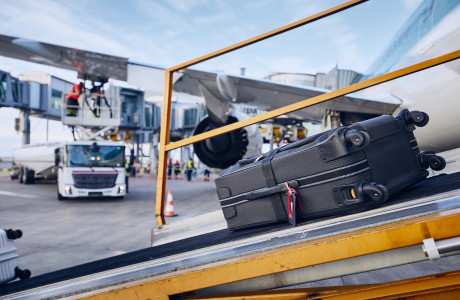
Belt loaders are airport vehicles fitted with an adjustable conveyor belt. They assist with loading and unloading by mechanically transporting baggage between the ground and the aircraft’s cargo hold.
Container and Pallet Loader
These mobile scissor-lift vehicles usually have two independent platforms that raise or lower containers and pallets to the height of the aircraft’s cargo hold. They are mainly used for heavy cargo and containerised loads on wide-body aircraft such as the Airbus A380.
Airport Vehicles for Supply and Ground Services
Refuelling Vehicle
A refuelling vehicle supplies an aircraft with fuel directly on the apron. It can pump up to 4,000 litres of aviation fuel per minute, allowing a Boeing 747 to be refuelled in approximately ten minutes. In addition to mobile fuel tankers, some airports use fixed underground hydrant systems, which allow aircraft to be refuelled via a connection in the ground.
Catering Vehicle
A catering vehicle resembles a conventional box van but is fitted with a lifting body and loading platform. The body can be raised, while the platform can be moved sideways, forwards and backwards to align precisely with the aircraft door. This allows meals, drinks and catering trolleys to be loaded directly into the aircraft galley.
Lavatory Service Vehicle
This airport vehicle empties and rinses the aircraft’s waste tanks and replenishes them with fresh servicing fluid. It is one of the most common types of ground support equipment found at airports.
Potable Water Service Vehicle
A potable water service vehicle refills the aircraft’s drinking-water tanks, ensuring that passengers and crew have access to clean water on board.
Airport Vehicles for Safety and Technical Support
Ground Power Unit
A ground power unit, or GPU, is often a stationary piece of equipment. However, mobile units are also used to supply aircraft with electrical power while they are on the ground. This means the aircraft’s auxiliary power unit does not have to remain running, reducing fuel consumption, emissions and noise.
De-Icing Vehicle
A de-icing vehicle is one of the most important airport vehicles for winter operations and at airports in cold regions. It removes frost, snow and ice from the aircraft’s fuselage, wings, flaps, tail surfaces and landing gear.
The vehicle sprays heated de-icing fluid, usually containing glycol, onto the aircraft to melt ice and help prevent further accumulation. This is essential for maintaining aerodynamic performance and ensuring safety during take-off.
Airport Fire Engine
Airport fire engines are specially designed vehicles operated by the airport fire and rescue service. They are equipped with extremely powerful pumps and are kept ready for immediate deployment. Airport fire crews must remain on standby whenever aircraft are taking off or landing.

Bird Control Vehicle
One of the more unusual airport vehicles is the bird control vehicle. This specially equipped off-road vehicle patrols runways and taxiways and uses gas cannons to produce loud bangs that frighten birds away.
It may also use loudspeakers that play birds of prey calls or bird distress signals. In some cases, pyrotechnic devices are used as well. The aim is always the same: to reduce the risk of bird strikes.
All these airport vehicles operate simultaneously in a confined area and under considerable time pressure for every single flight, 24 hours a day. What passengers can barely see from the terminal window is in fact a highly precise operation in which dozens of specialists and vehicles must work together in perfect coordination.